

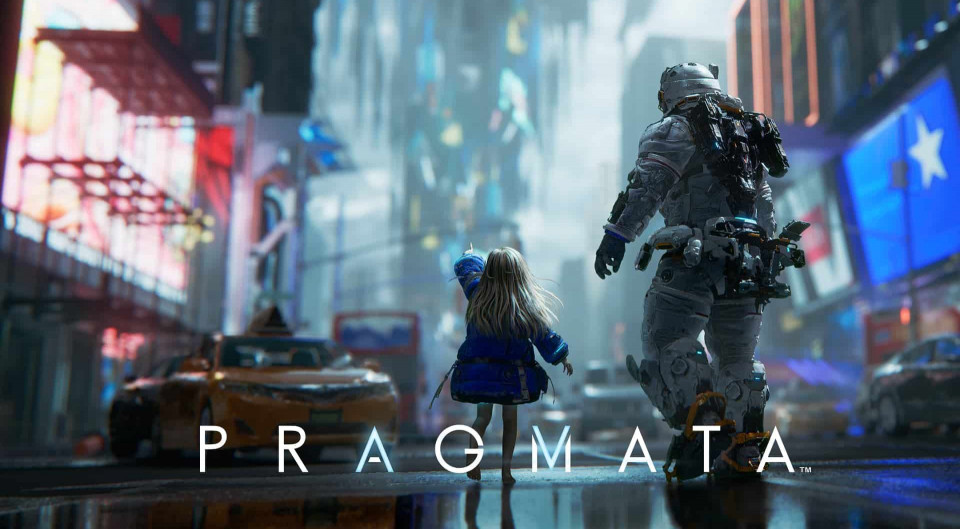
Having had the chance to try out a preview version of Pragmata for two hours about three weeks ago, we’ve compiled our impressions of Capcom’s upcoming game into a fairly concise video. We hope you’ll take the time to check it out, even though the footage you’ll see was provided by the publisher and we couldn't record an English version. Hopefully, the automated English subtitles will allow you to follow what we're saying about the game.
I was invited to a two-hour preview session at Capcom France’s new offices in Paris, and I really had a great time there. The Japanese publisher is really on a roll this year, following the releases of Resident Evil Requiem—which I absolutely loved and which got a full review on the site and on the channel—and Monster Hunter Stories 3, which davton really enjoyed and for which he also wrote an enthusiastic review. Pragmata had a demo available on all platforms, so if you’ve already tried it, there won’t necessarily be any surprises coming from me, but I find it has a strong kinship with the games we saw on the 360/PS3 generation. Games like SEGA’s Vanquish or Capcom’s Lost Planet—not because Pragmata borrows ideas from them, since the overall feel and approach are quite different, but because here we have a more linear game, more arcade-like to a certain extent—in short, more of a video game.
There’s obviously a story and some narrative, but I haven’t seen enough to tell you about it. I’ll just say that the unlikely duo vaguely reminded me of Ellie and Joel in the first The Last of Us. Diana is certainly an android, but she possesses the same kind of naive innocence, which she owes both to her very nature and to the fact that she has never seen anything other than the lunar base where the adventure takes place. Hugh, as a human, therefore has to regularly explain certain things to her, like life on Earth, for example. Since this preview session allowed us to explore a sort of New York recreated within the base, certain details are bound to elicit a reaction from the little girl, much like Ellie, who was regularly surprised by the apparent superficiality of the world before. I don’t yet know how this relationship between Diana and Hugh will play out, but from what little I’ve seen, I wouldn’t be surprised if Hugh grows very quickly attached to the girl—and if the player ends up feeling the same way.
The section I got to play picked up right where the demo left off, so I didn’t get to experience the game’s introduction or any plot twists, but the world is as intriguing as ever, and honestly, getting back into science fiction—especially in a potential new franchise—feels absolutely great.
I assume you already know what to expect in terms of gameplay: the two heroes complement each other in a way that requires you to manage two very distinct gameplay styles. On the surface, Pragmata is a simple third-person shooter, but the twist is that Hugh can’t deal enough damage to his enemies unless Diana hacks them first. The challenge is that the mini-game you must complete to successfully hack doesn’t pause the game at all. It requires you to pay attention both to the steps needed to succeed and to your enemies’ movements, as they may attack you in groups during that time. As you probably know, you’ll find hacking modules along the way that can give you an advantage, but you can also save them for specific situations—like the ability to hack multiple machines at once, for example. It’s a bit of a learning curve, though I found that the demo and preview were never particularly difficult in normal mode, and that’s what sets Pragmata apart from the competition.
In this preview, we see the same core mechanics as in the demo when it comes to exploration and combat, but the introduction of new enemies—which are trickier to deal with—made the two hours I spent playing the game really interesting, in my opinion. I don’t yet know what to expect in terms of variety over the long term, but for now, it’s off to a pretty good start, with well-executed designs and unique behaviors for each robot that make these encounters a lot of fun to tackle. The level design is linear, as I mentioned, but it offers some verticality, and there are always loot crates to find if you take the time to look around a bit, though these little side quests never distract us from our main objective for very long. In this preview, we once again had to activate a number of mechanisms—towers this time—to unlock the door leading to the area’s boss. Nothing very original in itself, it’s true, but wandering through this upside-down New York—somewhere between Inception and the less eerie oddities of Alan Wake 2—is very enjoyable and highlights the developers’ intentions in terms of environmental variety.
The real novelty for me—having only played the demo—is the ability to return to the heroes’ base at every save point in the game, the “campfires” of this universe, if you will, even though the comparison doesn’t really hold up since you don’t lose anything you’ve accumulated when you die and the enemies respawn. At the base, you’ll be able to upgrade Hugh’s suit, his main weapon, and Diana’s hacking ability, but that’s not all. So, I won’t list everything I’ve seen, but the presence of a 3D printer allows you not only to craft the secondary weapons you’ve unlocked by leveling up, but also hacking modules, and even more interestingly, ability upgrades. I’ll at least mention the ability to make Hugh’s dash more effective, because I think mobility is a key factor in a game like this, but there are other surprises to discover. I do hope, however, that more features will be added to the list, because in the two hours I spent playing, I managed to max out most of the available abilities. Still, this is a crucial aspect of this genre, and I’d be quite surprised if the heroes’ progression doesn’t live up to my expectations in the final game.
This preview naturally ended with a boss fight, one that was far more impressive than the one in the demo, though not necessarily more difficult. Keep in mind that I played on the default difficulty setting, and while defeating this impressive robot wasn’t a problem for me—I managed it on my first try—I really enjoyed the battle. You still alternate between hacking, dodging, and attacking, using weapons and hacking modules you can pick up off the ground, and everything on screen is very easy to follow.
I’ll go out on a limb and say that everything is looking up for Capcom, and I have every confidence in the publisher’s ability to deliver another excellent title. My only fear is that players won’t embrace it, as was the case with the equally excellent *Kunitsu-Gami*, which was likely too original to achieve the success it deserved. I’d be very disappointed to see Capcom stop offering us slightly different experiences in original universes, so I’m keeping my fingers crossed that players won’t snub the final version of Pragmata if it lives up to all the good things I think this preview session shows.

 Patreon




